Just Glimpse of, How Meditation-Mechanism is suprior to Sleep & Dream Physiology ???
Soul's Quantum Mechanism
The Scientific Definition of Meditaion–Mechanism: From a cosmocellular & psychophysiological perspectives,– Meditation is a self-regulatory neurophysiological-process in which focused awareness and reduced cognitive distraction produce coordinated changes in brain-activity, autonomic balance, respiration, cardiovascular function, cellular-repairing, endocrine regulation, and neural-plasticity,– resulting in a state of restful alertness and enhanced psychophysiological integration. From a philosophical perspective, meditation may be viewed as the progressive harmonization of consciousness with the body’s intrinsic neurobiological rhythms, whereby mental fluctuations diminish and awareness becomes increasingly unified, stable, and transparent.
From neurophysiology & cosmocellular perspectives: Actually, the sleep / dream state (vivid-sleep) / meditaion-mechanism are generally associated with the cortical activities of the subconscious and superconscious dimensions of the human-brain / mind, particularly within the cerebral-cortex of brain-system. A dream may be regarded as a meaningful yet apparently meaningless image; such visualized thoughts arise through the formation of mental images and concepts within the mind. Thus, dreams constitute one of the most valuable sources for the study of the subconscious and superconscious mind. They often reflect both our inner psychological experiences and our outer life events. Dreaming is primarily an electro-neurological phenomenon, originating largely within the cerebral-cortex, during which the brain processes thoughts, memories, emotions, and experiences in seemingly random, though sometimes symbolically organized, patterns. Occasionally, however, certain meaningful dreams appear to possess an extraordinary quality resembling forceful-intuition or profound insight. Nevertheless, the precise scientific and electroneurophysiological mechanisms underlying sleep and dreaming remain incompletely understood. Even modern science has not yet provided definitive answers to the fundamental questions: Why do we sleep? Why do we dream?
It is generally believed that our deepest thoughts, emotions, and experiences may manifest in vivid symbolic forms during dreams, particularly during Rapid Eye Movement (REM)-sleep. Such sleep-related mental activities ordinarily occur beyond the sphere of conscious voluntary control. Actually, to understand the physiology of sleepless-sleep, — that is, the neurophysiology of self-hypnosis and trance-meditation,— it is equally important to understand the natural mechanisms of sleep and dreaming from a neurophysiological and cytopsychophysiological perspectives. Sleep is a naturally recurring state of mental and physical rest, characterized by partial or near-complete suspension of voluntary bodily activities while remaining fundamentally arousable.
In other words, sleep / meditation is a restorative neurophysiological state involving a temporary reduction of conscious awareness. Various theories have been proposed to explain sleep-physiology, and among them some researchers have suggested functional alterations in cerebral blood flow or perfusion as one contributing factor. Physiologically, drowsiness commonly occurs after meals, when increased gastrointestinal blood-flow for digestion of food is accompanied by reducing-changes in a systemic blood-circulation and neural activity of human-brain, thereby promoting a state of relaxation and napping-like sleepiness (postprandial-drowsiness). During Napping (sleep-inertia),– a sympathetic (“fight-or-flight”) activity decreases; and simultaneously parasympathetic (“rest-and-digest”) activity increases. The principal regulatory centres governing sleep and wakefulness involve the suprachiasmatic nucleus (SCN) of the hypothalamus. The SCN functions as the body’s master biological-clock, coordinating numerous voluntary and involuntary physiological and psychological rhythms. These sleep-regulating centres interact with neurochemical-systems that respond to cycles of daylight and darkness. Light-sensitive retinal-cells of eyes detect environmental illumination and transmit signals to the SCN through the optic-pathways of eyes, thereby synchronizing circadian rhythms.
After all, both our artificial and natural efforts to induce sleep operate through the same underlying mechanisms of the sleep-regulating centers of the hypothalamus. However, in the consciously planned sleepless-sleep state of meditation,– a transient physiological cerebral-ischemia does not occur, unlike the transient sleep-inertia phenomenon that may arise during natural sleep, particularly following the food intake.
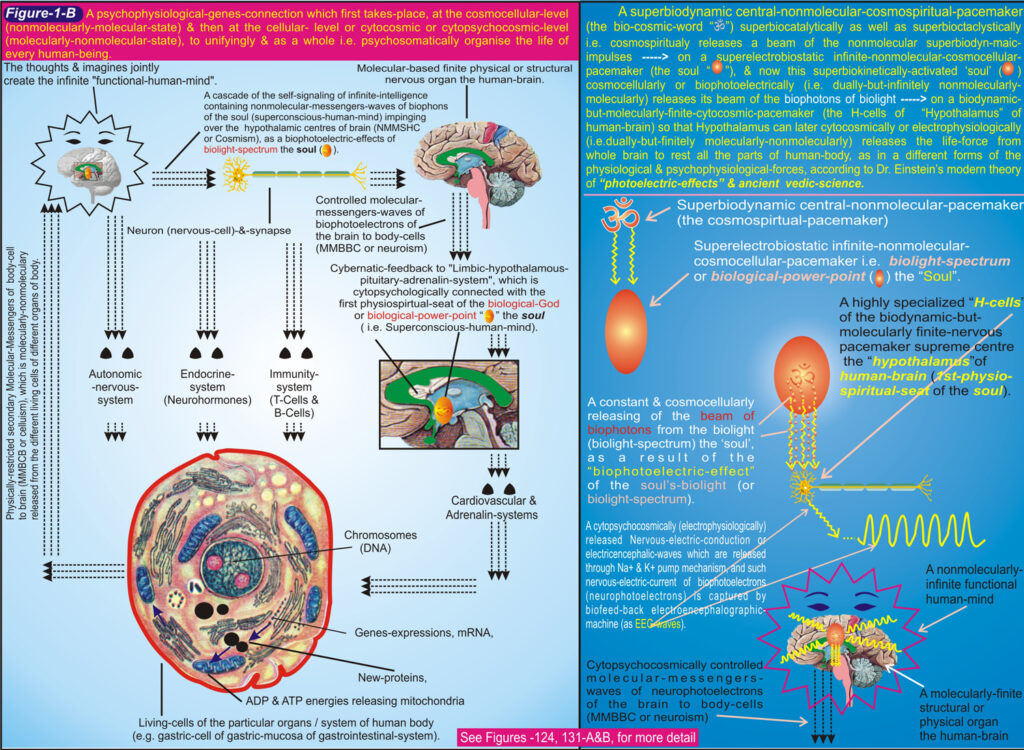
During REM-sleep,– the pons, a structure located within the brainstem,– becomes highly active and generates neural signals that suppress skeletal muscle activity through spinal pathways, thereby producing temporary bodily immobility. Meanwhile, shortly before and during sleep, the pineal-gland,— often symbolically referred to as the ‘biological-pyramid’ or ‘3rd-eye’ (or meditator’s eyes) or ‘Agna-Chakra’,— secretes the neurohormone melatonin, which promotes feelings of drowsiness and facilitates sleep onset. The pineal-gland itself is regulated by signals originating from the SCN. During sleep, and likewise during certain deep meditative-states, the pituitary-gland releases growth hormone, which stimulates protein-synthesis within living-cells. In developing individuals, this hormone contributes to bodily growth, while in adults it assists tissue repair, cellular-restoration, and physiological rejuvenation. Thus, natural sleep,—and the intentionally induced sleepless-sleep state associated with self-hypnosis and trance-meditation,—may be viewed not merely as mechanisms of relaxation and rest, but also as processes that support growth, healing, and psychosomatic restoration. From this perspective, many of the restorative benefits ordinarily associated with natural sleep may also be cultivated through disciplined meditative practice and self-hypnotic mental imagery.
Natural sleep and meditative sleepless-sleep share certain neurophysiological pathways involving hypothalamic regulation. However, according to this theoretical interpretation, deep meditative states maintain conscious awareness while avoiding some of the physiological reductions in alertness characteristic of ordinary sleep. Consequently, meditation may serve as a complementary means of restoring mental clarity and psychosomatic balance. From the perspective of Vedic contemplative philosophy, a Zero-Thought-based Trance-Meditation (TM) ‘Samadhi’ represents the transcendence or liberation of all mental modifications,– viz. negative and positive thoughts / deeds (karma), desires and aversions, actions and reactions, memories and anticipations etc..
In this sense, trance-meditation (TM) functions metaphorically like a biocosmic-black-hole, dissolving the psychological structures associated with the past and present. When the thought-generating process subsides, the cyclical perception of time also appears to diminish. The mind, which ordinarily constructs experience, becomes profoundly silent. Regular practice of trance-meditation (TM) gradually develops a highly potentialized mental-state that acts as a spiritual-platform for inner transformation. According to Vedic-philosophy,– Lord Shiva the Lord of Dhyana (Meditation), guides the soul (⬮) toward Moksha (Liberation). So, an unbound-soul (⬮), freed from the limitations and karmic influences of both past and present lives, ultimately merges into the Supreme-Soul (⬮). In this liberated condition, the individual soul (⬮), freed from the limitations of mental conditioning, merges with the Supreme-Soul (⬮). In other words, such a state of sleepless-sleep psychophysiologically enhances our neurotheological mechanisms, thereby nourishing and harmonizing our entire mental and physical being.
In a sake of simplification,– the induction of such Zero-Thought state (Trance-Meditation) may be understood as a process that regulates the entropy-driven force of Time toward a potential state of Zero-Time. In other words, it is a state of transcendence that carries one beyond the cyclical labyrinth-like Chakravyuh of the Time-Wheel.
From a psychophysiological perspective,– such sleepless-sleep states may enhance neurotheological processes that nourish both mental and physical well-being. Symbolically, the induction of a Zero-Thought-Time-State (constant-biological-time) may be viewed as reducing the entropic influence of psychological-time-force (divided-biological-time) toward a condition of “Zero-Time”, transcending the cyclic time–wheel of past, present, and future. Thus, during trance-meditation (TM), such time-wheel of finite divided-biological-time of (corporeal-formed or physical organ human-brain) transforms toward the infinite constant-biological-time of the subtle or incorporeal-formed biological-power-point (⬮), called the soul.
Furthermore, meditative-practice may improve cerebral-perfusion through enhanced respiratory efficiency, relaxation responses, and autonomic regulation, thereby supporting the metabolic-demands & oxygen-requirements of the nervous-system. Consequently, from a neurotheological viewpoint, the cultivated sleepless-sleep state of the sleepless-sleep or trance-meditation (TM) may offer benefits distinct from those of ordinary physiological-sleep (meditationless-meditation). Within Vedic contemplative traditions and certain self-hypnotic methodologies,– it is proposed that persistent mental activity can be gradually reduced through disciplined psychic-training and deep or trance meditation. As thought waves become increasingly quiet, the silent-mind approaches a condition resembling dream-free-rest while maintaining an underlying state of awareness. In this regard, deep or trance-meditation may be understood as a consciously sustained analogue of profound dreamless-sleep.
Hence, Vedic philosophy frequently describes Zero-Thought-based (Samadhi) trance-meditation (TM) as the transcendence of all mental modifications, karmic impressions, desires, and dualities. In metaphorical terms, it acts like the reformatting of a computer’s hard-drive, clearing accumulated psychological conditioning and enhancing the efficiency of consciousness itself. Through regular meditation-practice, the silent-mind becomes a divine platform upon which higher spiritual realization unfolds. At this stage, according to the Vedic philosophy, Lord Shiva elevates the soul (⬮) toward the Liberation (Moksha), where the cyclic-time-wheel-free i.e. liberated-soul (⬮) ultimately merges with the Supreme-Soul (⬮).
From a neurological standpoint,— the hippocampus is particularly sensitive to hypoxia and ischemia resulting from reduced cerebral-perfusion. Such conditions may damage memory-related neural structures and contribute to cognitive impairment, including forms of dementia following cardiac-arrest. This physiological vulnerability also underscores the importance of adequate oxygenation during Pranayama (deep-breathing practice), which may support optimal cerebral function and cognitive health.
Hippocampus of brain is highly sensitive to hypoxia-induced ischemia due to reduced cerebral-perfusion, that neuropathologically damages the memory-centres & cause for memory-deficiency (dementia), following cardiac-arrest. Here, this same neuropathophysiology justifies the respiratory-role of good oxygenation, during Pranayam (Deep-Breathing) that improves the memory.