What Is the Cosmocellular Hypothesis? A Complete Introduction
The Quantum Leap of Consciousness: A Cosmocellular Perspective
August 6, 2024India possesses one of the richest cultural, philosophical, scientific, and architectural heritages in human history. However, the challenge before us is not creation—but communication. We have not always effectively presented our intellectual and cultural legacy to the world.
Take Buddhism as an example. Though it originated in India, its systematic study, documentation, and global academic recognition were significantly shaped during the colonial period, particularly through scholarly institutions in Europe and England. Owing, in part, to the lack of sufficiently structured research and presentation within India itself, misconceptions regarding its origins and development even emerged.
Institutions such as Nalanda and Takshashila Universities were once global centers of learning, with immense libraries, scholars, philosophical traditions, and intellectual exchange. Yet, over time, others often studied, interpreted, documented, and presented aspects of this heritage more systematically and effectively than we did ourselves.
Today, our responsibility is clear: not only to preserve our heritage, but also to present it with intellectual rigor, systematic research, philosophical depth, and a global vision.
It is within this broader intellectual context that the Cosmocellular-Hypothesis seeks to raise a fundamental question about the relationship between the universe, life, consciousness, and the human experience.
From Cosmology to Cell Biology
Unquestionably, modern science has achieved remarkable progress in explaining the universe through Cosmology and in understanding the mechanisms of life through Cell Biology. Yet an intriguing question still remains:
Could the fundamental architecture of the universe share deeper principles with the organization of the living cell?
Throughout Nature, patterns often recur across different scales. From galaxies and large-scale cosmic structures to microscopic biological systems and living cells, certain structural similarities and organizational principles can appear surprisingly consistent.
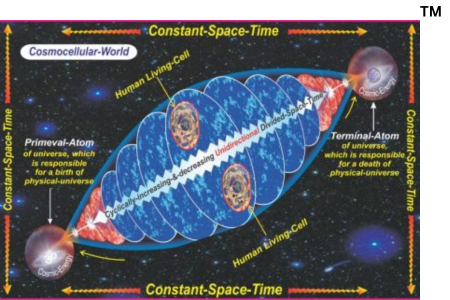
The Cosmocellular-Hypothesis explores a bold and thought-provoking possibility: that the large-scale structure of the Cosmos and the microscopic architecture of living cells may, in some manner, reflect underlying universal architectural principles.
In this framework, cosmic phenomena—or what may be described philosophically as cosmic intelligence or cosmism—may manifest themselves within the most miniature structural and functional unit of biological existence: the “Living Cell,” together with its non-molecular functional dimension, “Consciousness,” which may be understood conceptually as cellular intelligence or celluism.
The hypothesis therefore explores the possibility of a universal cosmocellular principle operating across different scales of existence.
“Brahmande So Pinde, Pinde So Brahmande”
At the philosophical heart of this concept lies the ancient principle:
“Brahmande So Pinde, Pinde So Brahmande;
Parmatma So Atma, Atma So Parmatma.”
ब्रम्हाण्डे सो पिण्डे । पिण्डे सो ब्रम्हाण्डे ॥
परमात्मा सो आत्मा । आत्मा सो परमात्मा ॥
In its philosophical interpretation, this principle expresses the idea that whatever exists in the greater universe is reflected, in some form, within the individual being, and that the Supreme Self and the individual Self are ultimately interconnected.
The statement “Brahmande So Pinde, Pinde So Brahmande” may therefore be understood as expressing a profound correspondence between the macrocosm and the microcosm.
Similarly, “Parmatma So Atma, Atma So Parmatma” expresses the philosophical idea that the Supreme Soul (Supreme Self) and the individual Soul (Self) are not ultimately separate.
The Cosmocellular-Hypothesis approaches these ancient philosophical ideas not merely as religious statements, but as questions worthy of deeper philosophical, metaphysical, and interdisciplinary investigation.
Was Ancient Vedic Science Merely Mythology?
One who studies the vast and profound corpus of the Vedas and the traditionally recognized 108 Upanishads may reasonably question whether such an enormous intellectual tradition should be understood merely as mythology.
Rather, these ancient texts may contain layers of philosophical, metaphysical, cosmological, and potentially scientific insight that remain open to further interpretation and investigation.
In this sense, the central proposition of the Cosmocellular-Hypothesis is that ancient Vedic science should not automatically be reduced to mythology. It may instead be viewed as a “Mysteriously Missing Science”—a body of ancient knowledge whose underlying principles may deserve renewed philosophical and interdisciplinary examination.
This does not mean that every statement contained in ancient texts should be treated as scientifically proven. Rather, it invites us to ask whether some ancient observations, concepts, metaphors, and philosophical principles can inspire new questions for contemporary science.
What Is the Cosmocellular-Hypothesis?
In short, the Cosmocellular-Hypothesis is neither a physics textbook nor a religious scripture.
Rather, it proposes a unique cosmological and philosophical framework that explores energy, matter, life, and consciousness as interconnected dimensions of a unified “Cosmocellular Intelligent Reality.”
The concept attempts to establish a bridge between seemingly different domains:
- Cosmology — the study of the universe and its large-scale structure
- Cell Biology — the study of the fundamental living unit
- Physics — the study of matter, energy, forces, and fundamental principles
- Consciousness — the exploration of awareness and subjective existence
- Vedic Philosophy — ancient Indian philosophical concepts concerning reality, Self, and the cosmos
- Meditation — the exploration of consciousness, awareness, and inner experience
- Metaphysics — questions concerning reality beyond what can presently be established through empirical observation
- Philosophy of Science — examination of how scientific knowledge is formed, interpreted, and expanded
The Cosmocellular-Hypothesis therefore presents itself as a bridging-science framework rather than a replacement for established scientific disciplines.
Cosmocellular-Hypothesis and Modern Physics
The Cosmocellular-Hypothesis does not seek to compete with Modern Physics.
Instead, it seeks to explore whether there may be a deeper metaphysical and hypothetical foundation from which future scientific questions can emerge.
Modern physics has transformed our understanding of space, time, matter, energy, quantum phenomena, and the structure of the universe. Yet science continues to encounter fundamental unanswered questions concerning consciousness, the origin of life, the nature of reality, and the relationship between observation and existence.
The Cosmocellular-Hypothesis asks whether a broader conceptual framework could potentially connect some of these questions.
It is therefore better understood as an exploratory hypothesis rather than an established scientific theory.
Cosmocellular-Hypothesis as a Philosophy Book
The Cosmocellular-Hypothesis can also be approached as a philosophy book—a work that invites readers to examine fundamental questions about existence, reality, consciousness, the universe, and the relationship between the individual and the cosmos.
It does not ask the reader to accept every proposition as established scientific fact. Instead, it encourages philosophical inquiry:
What if the universe and the living cell are expressions of deeper organizational principles?
What if the ancient relationship between the macrocosm and microcosm can be reconsidered through modern scientific questions?
What if consciousness deserves to be examined not merely as a biological phenomenon, but as part of a larger philosophical question about reality?
These questions form an important part of the intellectual journey presented through the Cosmocellular-Hypothesis.
Cosmocellular-Hypothesis and Meditation
The connection with meditation is another important dimension of this framework.
Meditation has been explored for thousands of years within Indian philosophical traditions as a means of examining consciousness, awareness, the mind, and the nature of the Self.
For this reason, the Cosmocellular-Hypothesis may also be of interest to readers searching for a meditation book that goes beyond meditation as a simple relaxation technique and instead considers meditation within a broader philosophical and cosmological context.
The relationship between meditation, consciousness, the Self, and the cosmos raises questions that lie at the intersection of philosophy, spirituality, psychology, neuroscience, and the study of human experience.
The hypothesis explores whether the inward investigation associated with meditation and the outward investigation associated with science might ultimately be asking complementary questions about the same underlying reality.
A Bridge Between Ancient Knowledge and Future Science
The central vision of the Cosmocellular-Hypothesis is therefore not to reject modern science or romanticize the ancient world.
Rather, it is to create a dialogue between ancient philosophical knowledge and modern scientific inquiry.
Ancient Indian traditions explored profound questions concerning:
Who are we?
What is consciousness?
What is the relationship between the Self and the universe?
What is the nature of reality?
How are the individual and the cosmos connected?
Modern science approaches some related questions through entirely different methods:
What is the universe made of?
How did it evolve?
How does matter organize itself?
How did life emerge?
How do cells function?
What is consciousness?
The Cosmocellular-Hypothesis proposes that these apparently different lines of inquiry may eventually intersect.
Conclusion
The Cosmocellular-Hypothesis is an attempt to explore a profound possibility: that the Cosmos, the living cell, consciousness, and the human Self may be interconnected expressions of deeper universal principles.
Its philosophical foundation draws inspiration from the ancient principle:
“Brahmande So Pinde, Pinde So Brahmande.”
Its scientific curiosity looks toward Cosmology, Cell Biology, Physics, Thermodynamics, and the study of consciousness.
Its inward dimension connects with meditation and the exploration of the Self.
And its broader philosophical purpose is to ask whether humanity can build a meaningful intellectual bridge between ancient knowledge and future science.
The Cosmocellular-Hypothesis therefore remains an exploratory hypothesis and philosophical framework, inviting further questioning, research, interpretation, and debate.
Perhaps the most important question is not whether the final answers have already been discovered.
Perhaps the more important question is:
Are we asking the right questions about the relationship between the Cosmos, the Cell, Consciousness, and the Self?
For readers interested in these questions, the Cosmocellular-Hypothesis can be approached as both a philosophy book and a meditation book, while also serving as an invitation to explore the boundaries between cosmology, biology, consciousness, ancient Indian philosophy, and the future of scientific thought.
